Introduction
The United States Constitution is the foundation of American government and the supreme law of the nation. It establishes the federal government’s structure, distributes authority among its branches, defines the relationship between federal and state governments, and provides the foundation for essential constitutional rights.
If you are looking for the US Constitution Text, the complete document consists of the original Preamble, seven articles, and 27 ratified amendments.
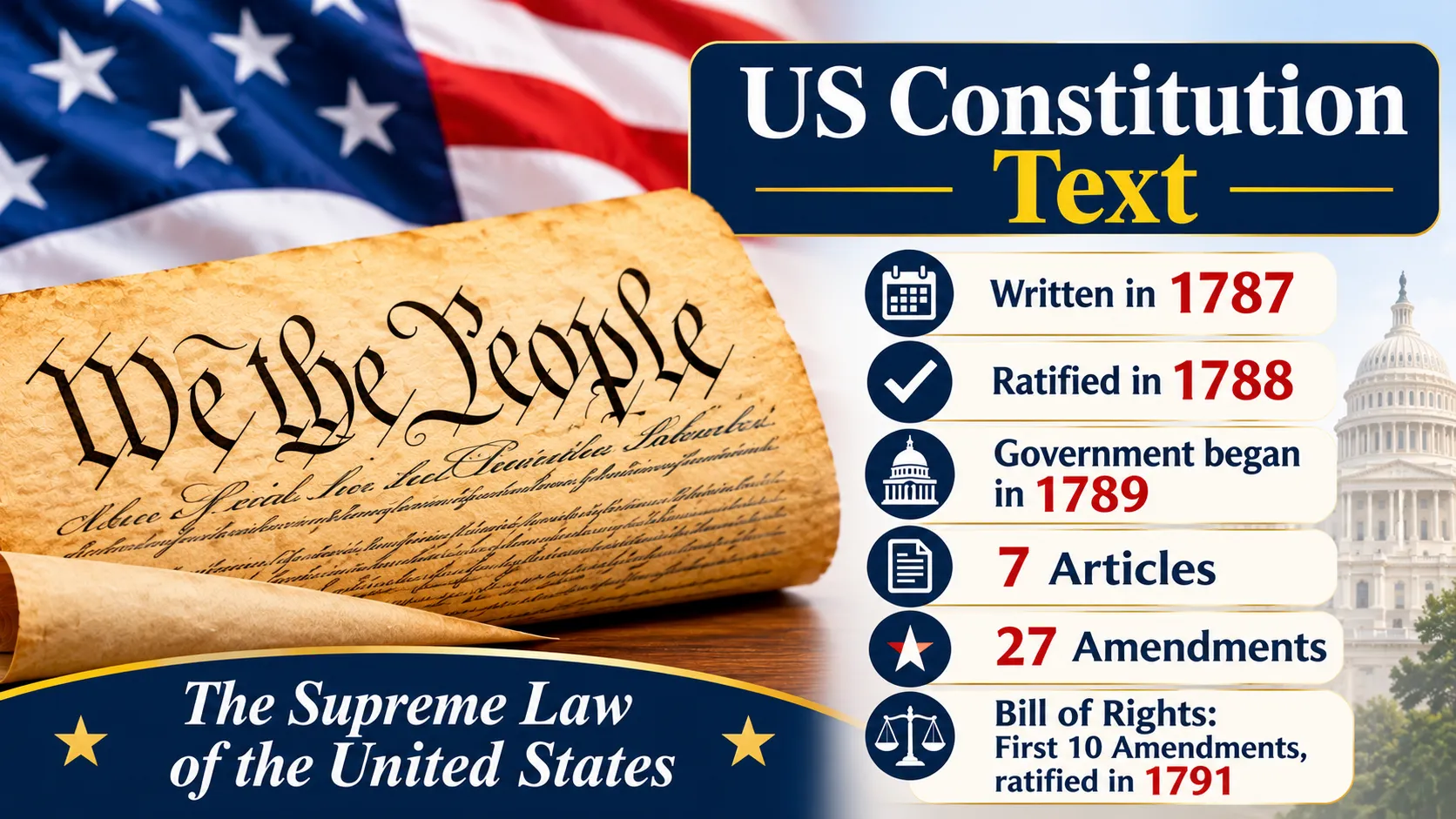
The Constitution was written in 1787, ratified in 1788, and became operational in 1789. Its first ten amendments, collectively known as the Bill of Rights, were ratified in 1791.
This guide explains the document’s organization, provides access to the complete constitutional text, examines every article and amendment, and explains how the Constitution continues to operate today.
What Is the United States Constitution?
The United States Constitution is the country’s fundamental governing document. It establishes the institutions of federal government, grants and limits their authority, and defines essential constitutional relationships.
Unlike an ordinary federal statute, the Constitution cannot be changed through the regular legislative process. Formal changes generally require the demanding amendment procedures established by Article V.
Three important functions of the Constitution are:
- Establishing the federal government’s legislative, executive, and judicial branches.
- Dividing governmental authority between the federal government and the states.
- Establishing enforceable constitutional limitations and protections.
The Constitution also creates a system of checks and balances intended to prevent excessive concentration of governmental authority.
Quick Facts About the US Constitution
| Question | Answer |
| When was it written? | 1787 |
| When was it signed? | September 17, 1787 |
| When was it ratified? | June 21, 1788 |
| When did the new government begin? | 1789 |
| Number of original articles | Seven |
| Number of ratified amendments | 27 |
| First ten amendments | Bill of Rights |
| Bill of Rights ratification | December 15, 1791 |
| Most recent ratified amendment | 27th Amendment, 1992 |
Read the Full Original US Constitution Text
The original Constitution contains a Preamble followed by seven articles divided into sections and clauses.
Readers should distinguish between the historical wording of the original document and the Constitution’s present legal effect. Certain original provisions have been changed or superseded by later amendments.
Access the complete constitutional text
The following official resources provide the actual wording rather than summaries.
National Archives — Original Constitution
Historical transcription preserving the document’s original wording and structure.
United States Senate — Complete Constitution
The Preamble, all seven articles, and the constitutional amendments in one navigable reference.
Congress — Constitution Annotated
Constitutional provisions accompanied by legal analysis and relevant judicial interpretation.
The official transcriptions above contain the full document. The following sections provide an educational explanation of its provisions; they are not presented as a verbatim reproduction of every constitutional clause.
The Preamble to the US Constitution
The Preamble introduces the Constitution and explains the broad purposes behind establishing the American constitutional system.
It begins with three historically significant words:
“We the People”
Those words express the principle that the government’s legitimacy derives from the people.
The Preamble identifies six broad constitutional objectives:
- Form a more perfect union.
- Establish justice.
- Ensure domestic tranquility.
- Provide for the common defense.
- Promote the general welfare.
- Secure the blessings of liberty.
These objectives explain the Constitution’s underlying purposes.
However, the Preamble is primarily introductory. It does not independently grant Congress additional legislative powers or establish standalone enforceable individual rights.
The Seven Articles of the US Constitution Explained
The original Constitution contains seven articles, each addressing an essential component of the American governmental system.
| Article | Main subject |
| Article I | Legislative branch |
| Article II | Executive branch |
| Article III | Judicial branch |
| Article IV | Relationships among states |
| Article V | Constitutional amendments |
| Article VI | Federal supremacy and constitutional obligations |
| Article VII | Ratification |
Article I: The Legislative Branch
Article I establishes the United States Congress, consisting of two chambers:
- House of Representatives
- Senate
Congress exercises the legislative powers granted by the Constitution.
Article I addresses congressional elections, representation, legislative procedures, taxation, commerce, federal spending, and other enumerated congressional powers.
It also imposes restrictions on Congress and the states.
For example, Congress has constitutional authority to regulate interstate commerce, but that authority is not unlimited.
Article I is the longest of the seven original articles.
Why it matters: It establishes the institutional framework through which federal legislation is developed and enacted.
Article II: The Executive Branch
Article II establishes the presidency and vests federal executive power in the President.
It addresses presidential qualifications, selection, responsibilities, and removal.
Important presidential responsibilities include executing federal laws, serving as Commander in Chief, and exercising constitutionally specified appointment and treaty powers.
Certain presidential actions require Senate participation. For example, treaties generally require the advice and consent of two-thirds of senators present.
Article II also establishes grounds for impeachment and removal.
Why it matters: It provides the constitutional foundation for presidential authority while placing that authority within a system of institutional checks.
Article III: The Judicial Branch
Article III establishes the Supreme Court and authorizes Congress to create lower federal courts.
It defines the scope of federal judicial power and establishes important protections concerning federal judicial tenure and compensation.
Article III also addresses treason.
Federal courts resolve cases within their constitutional and statutory jurisdiction. Through constitutional adjudication, they play an important role in determining whether governmental actions comply with constitutional requirements.
Why it matters: Article III provides the foundation for an independent federal judiciary.
Article IV: Relations Among the States
Article IV addresses relationships among individual states and between states and the federal Union.
Its provisions include:
- Full Faith and Credit.
- Privileges and Immunities.
- Admission of new states.
- Federal guarantees concerning state government.
- Protection against invasion and certain domestic violence.
For example, the Full Faith and Credit Clause establishes constitutional obligations concerning recognition of other states’ public acts, records, and judicial proceedings.
Why it matters: Article IV helps maintain a functioning national union composed of separate states.
Article V: The Amendment Process
Article V establishes the formal procedures for changing the Constitution.
Amendments may be proposed through Congress or a convention called following applications from the required number of state legislatures.
A proposed amendment must subsequently obtain ratification from three-fourths of the states through the constitutionally prescribed method.
This demanding process helps distinguish constitutional change from ordinary legislation.
Article VI: Federal Supremacy
Article VI contains the Supremacy Clause.
It establishes that the Constitution, federal laws made pursuant to it, and treaties made under United States authority constitute the supreme law of the land.
This means valid federal law generally prevails when it conflicts with state law.
However, federal supremacy does not mean every federal action is automatically constitutional. Federal governmental authority remains subject to constitutional limitations.
VI article also requires relevant public officials to support the Constitution and prohibits religious tests as qualifications for federal public office or public trust.
Article VII: Ratification
Article VII established the original procedure for ratifying the Constitution.
Approval by conventions in nine states was sufficient for the Constitution to become established among the ratifying states.
New Hampshire became the ninth state to ratify the document on June 21, 1788.
This marked a decisive step in replacing the Articles of Confederation with the new constitutional framework.
All 27 Amendments to the US Constitution
The Constitution has been formally amended 27 times.
Amendments have changed important aspects of American government, expanded constitutional protections, altered election procedures, and addressed fundamental questions about citizenship, equality, and individual liberty.
The first ten amendments form the Bill of Rights. The remaining seventeen were ratified between 1795 and 1992.
The Bill of Rights: Amendments 1–10
The Bill of Rights was ratified on December 15, 1791.
It establishes important limitations on governmental authority and recognizes essential individual protections.
| Amendment | Main constitutional protection |
| First | Religion, speech, press, assembly, and petition |
| Second | Right to keep and bear arms |
| Third | Restrictions on quartering soldiers |
| Fourth | Protection against unreasonable searches and seizures |
| Fifth | Due process, self-incrimination, double jeopardy, and property protections |
| Sixth | Rights of defendants in criminal prosecutions |
| Seventh | Civil jury trials in specified federal cases |
| Eighth | Excessive bail, excessive fines, and cruel and unusual punishment |
| Ninth | Recognition of rights not expressly enumerated |
| Tenth | Reservation of undelegated powers to the states or people |
The Bill of Rights originally restricted the federal government. Through subsequent constitutional developments, including Fourteenth Amendment jurisprudence, many of its protections have become applicable against state governments.
Not every constitutional guarantee operates identically against federal and state authorities.
Amendments 11–27
The remaining amendments address governmental structure, elections, citizenship, civil rights, presidential succession, and other constitutional matters.
| Amendment | Ratified | Main purpose |
| 11th | 1795 | Limits certain federal lawsuits against states |
| 12th | 1804 | Revises presidential and vice-presidential electoral procedures |
| 13th | 1865 | Abolishes slavery and involuntary servitude, subject to its express criminal-punishment exception |
| 14th | 1868 | Establishes citizenship protections, due process, and equal protection, among other provisions |
| 15th | 1870 | Prohibits denial or abridgment of voting rights based on race, color, or previous condition of servitude |
| 16th | 1913 | Authorizes federal income taxation without apportionment among states |
| 17th | 1913 | Establishes direct election of U.S. senators |
| 18th | 1919 | Established nationwide alcohol prohibition |
| 19th | 1920 | Prohibits denial or abridgment of voting rights on account of sex |
| 20th | 1933 | Changes the beginning and ending dates of presidential and congressional terms |
| 21st | 1933 | Repeals the 18th Amendment |
| 22nd | 1951 | Establishes limits on presidential election |
| 23rd | 1961 | Grants presidential electors to Washington, D.C. |
| 24th | 1964 | Prohibits poll taxes in federal elections |
| 25th | 1967 | Addresses presidential succession, vice-presidential vacancies, and presidential inability |
| 26th | 1971 | Protects voting rights for citizens aged 18 and older |
| 27th | 1992 | Regulates when congressional compensation changes may take effect |
These summaries describe each amendment’s central purpose, not every legal qualification or judicial interpretation.
The 18th Amendment is particularly important historically because it was subsequently repealed by the 21st Amendment.
The 13th, 14th, and 15th Amendments are collectively known as the Reconstruction Amendments. They fundamentally changed American constitutional law following the Civil War.
The US Constitution Explained in Simple English
The Constitution can be understood as a framework answering four fundamental questions:
Who makes federal laws?
Congress exercises the legislative powers granted by the Constitution.
Who executes federal laws?
The President heads the executive branch and exercises constitutionally assigned executive authority.
Who resolves federal legal disputes?
The federal judiciary decides cases within its jurisdiction.
What limits governmental authority?
The Constitution establishes powers, restrictions, institutional checks, and individual protections.
The document also recognizes the continuing constitutional role of state governments.
For example, states retain significant authority over education, property law, family law, and many other matters, subject to applicable federal constitutional and statutory requirements.
This is why understanding American law often requires examining both federal and state legal rules.
Six Fundamental Principles of the Constitution
1. Popular Sovereignty
Popular sovereignty means legitimate governmental authority ultimately derives from the people.
The Constitution reflects this principle through representative institutions and its ratification history.
2. Limited Government
Governmental institutions cannot lawfully exercise unlimited authority.
Their actions must comply with the Constitution and applicable legal requirements.
3. Separation of Powers
The Constitution distributes federal governmental responsibilities among legislative, executive, and judicial branches.
This institutional arrangement helps prevent excessive concentration of authority.
4. Checks and Balances
The branches possess mechanisms through which they can influence or restrain one another.
For example, the President may veto legislation, while Congress can override a presidential veto through the required two-thirds vote in each chamber.
The Senate also exercises important constitutional responsibilities concerning specified appointments and treaties.
5. Federalism
Federalism describes the constitutional division of authority between the national government and the states.
The Tenth Amendment reinforces the principle that powers not delegated to the United States or prohibited to the states are reserved to the states respectively or the people.
6. Constitutional Supremacy
The Constitution occupies the highest position within the American legal system.
Neither federal nor state governmental action may lawfully override its requirements.
History of the US Constitution: Important Dates
Understanding the Constitution’s historical development helps explain why particular provisions and amendments exist.
- 1787 — Constitutional Convention
Delegates gather in Philadelphia and develop a new governing document to replace the existing Articles of Confederation framework. - September 17, 1787 — Signing
The proposed Constitution is signed. - June 21, 1788 — Ratification threshold
New Hampshire becomes the ninth state to ratify the Constitution. - 1789 — New federal government
The new constitutional government begins operating. - December 15, 1791 — Bill of Rights
The first ten amendments are ratified. - 1865–1870 — Reconstruction Amendments
The 13th, 14th, and 15th Amendments transform constitutional protections concerning slavery, citizenship, equality, and voting. - 1920 — Women’s voting rights
The 19th Amendment is ratified. - 1971 — Voting age
The 26th Amendment establishes constitutional voting protections for citizens aged 18 and older. - 1992 — Congressional compensation
The 27th Amendment becomes the most recently ratified constitutional amendment.
Original Constitution vs. Constitution as Amended
An important distinction when studying constitutional law is that the original 1787 text does not always describe the current constitutional framework.
Later amendments have changed or superseded certain original provisions.
| Original constitutional arrangement | Subsequent constitutional change |
| Senators selected by state legislatures | 17th Amendment establishes direct election |
| Original presidential electoral procedure | 12th Amendment revises the process |
| Original apportionment framework | 14th Amendment modifies it |
| Original presidential term commencement | 20th Amendment changes relevant dates |
| No express two-election presidential limit | 22nd Amendment establishes one |
For example, someone reading only the original text might incorrectly conclude that state legislatures still select U.S. senators.
The 17th Amendment changed that arrangement.
Similarly, the original Constitution contains historical provisions addressing slavery that cannot be understood as statements of present constitutional law without considering subsequent amendments.
Practical reading tip: Whenever you encounter an original constitutional provision, check whether a later amendment affects its present legal operation.
How Is the US Constitution Amended?
Article V establishes two methods for proposing amendments and two methods for ratification.
Step 1: Proposing an Amendment
An amendment can be proposed through either:
- Approval by two-thirds of both houses of Congress.
- A constitutional convention called by Congress following applications from the legislatures of two-thirds of the states.
With 50 states, the second method requires applications from 34 state legislatures.
Step 2: Ratifying an Amendment
After an amendment is proposed, Congress selects one of two ratification methods:
- Ratification by the legislatures of three-fourths of the states.
- Ratification by conventions in three-fourths of the states.
Currently, either method requires approval from 38 states.
The President does not possess an Article V approval or veto role in the amendment process.
Article V also provides that no state may be deprived of its equal suffrage in the Senate without its consent.
This constitutional process makes formal amendments substantially more difficult than passing ordinary legislation.
Where Can You Download the US Constitution PDF?
Readers who want to study the Constitution offline can use government-published copies.
The U.S. Government Publishing Office provides downloadable editions of the Constitution and related constitutional materials.
The National Archives also provides access to historical founding documents and high-resolution images.
For legal research, check whether a downloaded edition contains explanatory commentary, historical wording, current amendments, or subsequent judicial interpretation.
These materials serve related but different purposes.
How to Read and Understand the Constitution Effectively
Readers do not need formal legal training to begin studying the Constitution.
A useful reading approach is to follow the document’s structure rather than attempting to memorize every provision immediately.
Start with the Preamble to understand its general purposes. Then read Articles I, II, and III to understand the three branches of federal government.
Continue through Articles IV–VII to learn about federalism, amendments, supremacy, and ratification.
Next, examine the Bill of Rights, followed by the Reconstruction Amendments and later constitutional changes.
When researching a particular constitutional question, distinguish among three different materials:
| Material | What it provides |
| Original constitutional text | Historical wording of the adopted document |
| Constitutional amendments | Formal changes to the Constitution |
| Judicial interpretation | Legal explanations of how constitutional provisions apply |
This distinction is especially important for subjects such as freedom of speech, search and seizure, due process, and equal protection.
The constitutional wording provides the foundation, but understanding a modern legal dispute may require examining applicable Supreme Court decisions and subsequent legal developments.
People Also Ask: US Constitution Text
The National Archives provides an authoritative transcription of the original Constitution and separate amendment transcriptions. The United States Senate also offers a navigable version containing the Preamble, seven articles, and amendments.
The original United States Constitution contains seven articles. They establish the federal government’s structure and address interstate relationships, constitutional amendments, supremacy, and ratification.
The Constitution has 27 ratified amendments. The first ten form the Bill of Rights, ratified in 1791. The most recently ratified amendment is the 27th Amendment, adopted in 1992.
Yes. The Bill of Rights consists of the first ten amendments to the United States Constitution. It is part of the Constitution rather than a separate governing document.
Yes. Article V establishes the formal constitutional amendment process. Proposed amendments must satisfy constitutional proposal requirements and obtain ratification from three-fourths of the states.
Conclusion Of US Constitution Text
The United States Constitution remains the foundation of the American legal and governmental system.
Its Preamble, seven original articles, and 27 Amendments establish the structure of federal government, define constitutional authority, and provide essential protections and limitations.
Understanding the US Constitution text requires more than reading isolated passages. Readers should consider the original wording, subsequent amendments, historical context, and applicable judicial interpretation together.
For the most reliable understanding, begin with the official constitutional text and consult authoritative government resources when researching specific provisions.